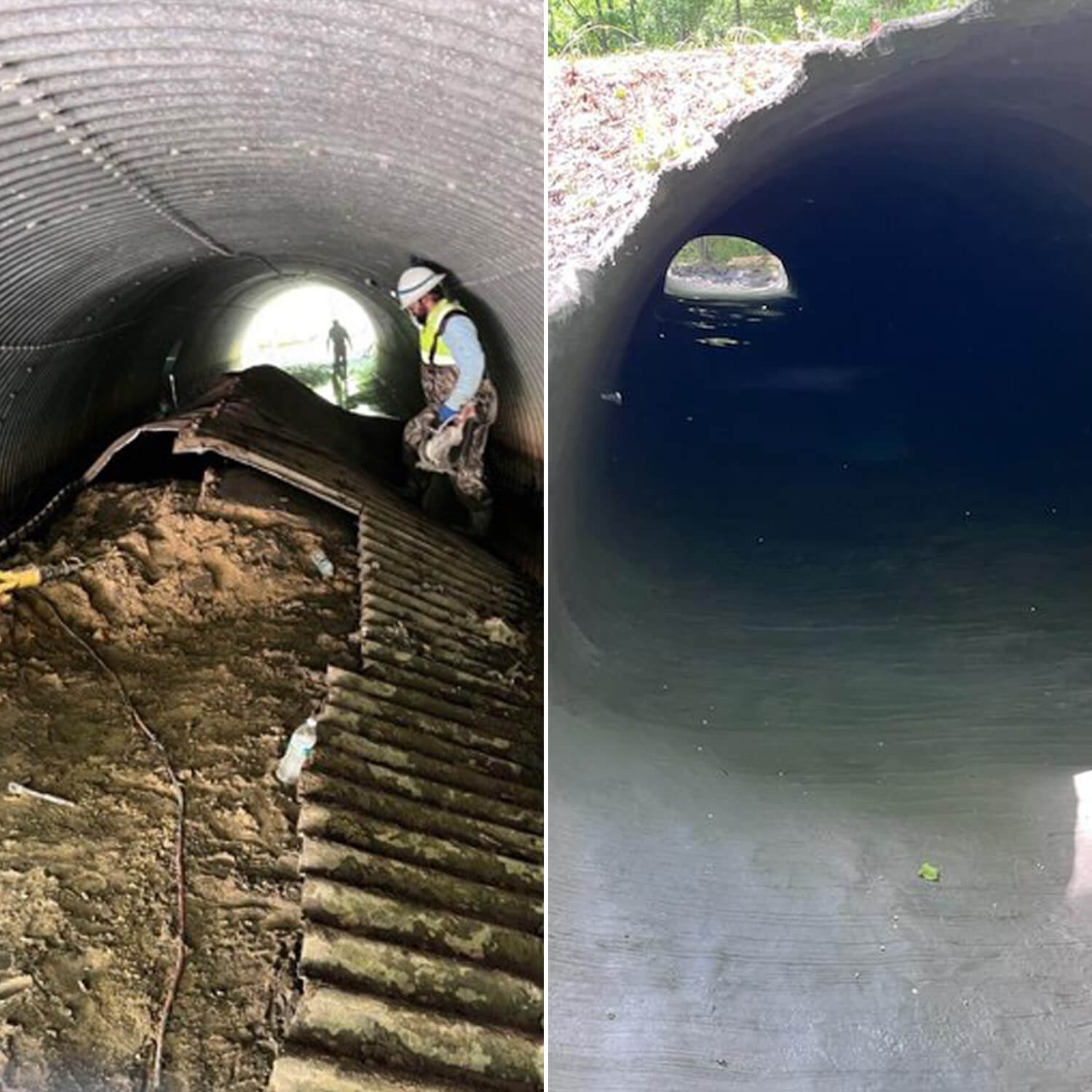
Culverts play a vital role in the safety and efficiency of today’s complex and sprawling infrastructure.
Unfortunately, dilapidated or failing culverts are a common infrastructure problem. Regardless of the material structure — stone and masonry, reinforced concrete, corrugated metal (steel or aluminum), solid-wall steel or iron – maintaining culverts and implementing expedient repair and restoration processes, ensure that our roads, bridges, highways, and byways remain safe and clear of flood hazards and stormwater runoff.
Culvert failures can occur for a variety of reasons but understanding the cause of the deterioration is the key to developing an effective plan to replace, rehabilitate or repair the culvert. Every effort should be made to reduce or eliminate the source of deterioration, either by modifying the original design or selecting an alternative material that is less susceptible to the source of deterioration.
A culvert that is partially deteriorated is a good candidate for rehabilitation whereas a fully deteriorated culvert would likely require replacement.
Observable conditions that indicate that a culvert’s structural integrity, function or flowline have been compromised include:
- Poor drainage (within and around pipeline)
- Blockage
- Cracks and apparent structural damage
- Slabbing (where concrete slabs are peeling from the sides of the pipe)
- Excessive deflections (due to load on the pipe)
- Loss/erosion of invert
- Joint separation and infiltration of soil
- Sink holes
The failure of a culvert can result from a myriad of causes ranging from poor maintenance, environmental stressors, capacity and volume issues, soil erosion, to structural or material failure including:
- Excessive loading that exceeds culvert design capacity
- Increased loading due to increased soil or groundwater elevations
- Improper bedding of culvert
- Inadequate piping of materials on exterior of culvert
- Infiltration (loss of soil through pipe wall or joints)
- Erosion of culvert material due to stream bed loading
- Environmental corrosion or stress cracking in pipe material
- Corrosion of structural reinforcement (as in concrete reinforced pipe)
- Freeze-thaw deterioration
- Movement of pipe due to slope erosion, freeze-thaw or settlement or structural deterioration
Upon the completion of inspection and assessment, the deterioration level of the culvert will be categorized as either partially or fully deteriorated. A culvert that is partially deteriorated is a good candidate for rehabilitation whereas a fully deteriorated culvert would likely require replacement.
Culvert Rehabilitation
The rehabilitation methods discussed below are intended to restore the culvert to its initial condition or better, including providing structural support. These are the commonly used methods for culvert restoration:
Cured-in-place-pipe lining (CIPP)
This process involves inserting a flexible liner inside an existing pipe, inflating the liner, and exposing it to heat or ultraviolet light to dry and harden the liner inside the pipe. Though versatile, CIPP lining requires a heavy preparation before installation and is best used on pipes that require minimal structural reinforcement. Additionally, the costs of CIPP lining tend to increase for larger pipes due to material weight and cost and the difficulty of installation.
Cast-in-place pipelining
Using the cast-in-place restoration method can successfully – and cost effectively—restore severely deteriorated large diameter regardless of the pipeline’s shape, type or condition. Expertly applied, the high-strength cementitious coating usually contains a proprietary blend of additives that make the compromised pipeline impermeable. To further prevent cracking and shrinkage, epoxies and urethane coatings can be applied to the cementitious lining that are resistant to bacterial and chemical exposure. This method is designed to rehabilitate pipelines with diameters ranging from 30″ to 120″.
Spin Casting or Centrifugally Cast Lining
This versatile repair / restoration method that is, applied to the culvert interior, relies upon a precisely controlled spin caster that is inserted into the pipe and withdrawn at a calculated speed controlling the thickness. The thin layers of high-strength, cementitious grout or mortar that adheres to the original substrate provides corrosion protection and enhances the structural capacity. (Mixes are proprietary and provide an abrasion-, and corrosion-resistant final product.) Spin casting is an efficient, long-lasting structural repair method for large diameter pipe and is often more cost effective than other options. Pipes between 30 inches and 120 inches in diameter can be lined in this way.
Sliplining
Sliplining, another form of trenchless rehabilitation, is used to repair leaks or restore the structural stability and integrity of an existing pipeline. Sliplining offers all the benefits and service life of a new pipe with minimal construction disruption and, as with storm culverts, often without bypass pumping.
The sliplining method can be utilized for any size pipe where there is appropriate access, and that a new pipe is small or large enough to “slip in and line” the host pipe. The insertion of the smaller pipe will effectively strengthen the structural integrity and repair any issues with the infiltration of water and soil. If the host pipe is in a structurally sound condition (no sagging, or shape loss in pipe), then sliplining is generally a cost-effective rehabilitation method.
Geopolymer Pipelining
Geopolymer pipelining is the next generation of trenchless structural renewal for storm and wastewater infrastructures. There is a great and increasing versatility in the application and use of these formulations. Geopolymer pipelining is a fully structural, corrosion-resistant lining material used in the rehabilitation and restoration of large diameter pipes, culverts, manholes, and other structures. It can be applied to most surface materials and to any structural shape. Proven as a long-term solution, geopolymers are designed to be resistant to bacterial and chemical corrosion which helps prevent future infiltration/exfiltration leakage and improves the overall performance and strength of the structure. This process can be applied to pipelines sized 36” or larger.
Shotcrete Liners
Shotcrete is a trenchless process whereby a high volume of a concrete mixture is sprayed through a hose and pneumatically projected on the culvert surface at high velocity. The concrete is compacted due to the force of the application process and, depending upon the thickness desired, multiple layers can be applied. This method is most appropriate for large diameter culverts (5 feet or greater) because it must be applied manually as the application nozzle needs to be perpendicular to the culvert surface. This technique is often used for cost-effectively repairing sewage and water pipelines.
Culvert Repair
Repair methods keep the existing culvert in a uniformly good, safe and operational condition but they do not necessarily enhance its structural integrity. (If that is the owner’s desired outcome, then rehabilitation methods should be considered.) The primary focus of repairing or patching is to fix the issue and stop further deterioration.
Materials play an important role in the effectiveness and durability of a repair. Patching materials should have similar strength, elasticity, etc. as the host material to prevent debonding.
Periodic inspections and routine maintenance should be conducted, and the repairs should be watched closely for delamination.
About MCSP
MCSP provides proven restoration solutions for aging culverts and stormwater systems.
Utilizing the latest in trenchless technologies and applications, MCSP restores and improves the structural integrity and functionality your deteriorated culverts and pipelines – extending their service life 50-plus years.
We are proud of our 20-plus years of experience as pipeline and culvert restoration experts.